


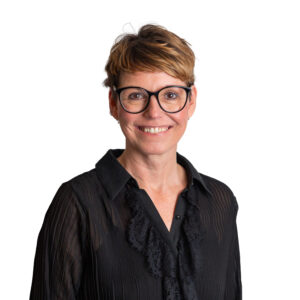
An organisation may have its risk assessment, procedures and personal protective equipment in order and still experience recurring incidents. In such cases, the problem rarely lies in yet another form. It is about what people do when the schedule runs over or someone spots an unsafe situation. Hanneke Jansen, safety culture expert at Kader and SCL Knowledge Partner at NEN, uses the Safety Culture Ladder (SCL) in her consultancy work to make that everyday behaviour visible and open to discussion.
The culture starts right at the barrier
When Jansen pays a visit, she doesn’t start by consulting a handbook. She begins observing the moment she steps onto the premises. “Culture is in the walls,” she says. “When I arrive at an organisation, I start paying attention right from the barrier. How warmly am I welcomed? How logical is the route? At the coffee machine, I check if it’s a bit of a mess and whether any messages are being shared with me via posters or the like. These are all observable expressions of culture.”
The SCL focuses on safety awareness, attitude and behaviour. Auditors conduct interviews and observe practices in the workplace. This provides a picture of the culture that actually exists, rather than just what the organisation has set out on paper.
Effective systems remain essential. A risk assessment and evaluation, clear procedures and appropriate protective equipment form the basis. However, they do not guarantee that people will discuss risks or hold each other to account. Jansen: “The foundations must be in place. That contributes to the reliability and predictability of an organisation. Ultimately, it is the people who shape the culture.”
How does a leader respond when under time pressure?
Exemplary behaviour becomes apparent as soon as other priorities come into play. Does a manager continue to allow scope for careful execution if a task runs over time? Does a training course go ahead even if the budget falls short? Is worn-out personal protective equipment replaced in good time?
According to Jansen, such decisions carry more weight than a speech about safety. “If you say in the morning that you consider safety to be very important, but at the end of the day, when under time pressure, you shout ’go go go‘ and ignore the rules, then you’ve been found out. Then suddenly you find yourself 1–0 down again.’
A one-off message does not change behaviour. Leaders must continue to promote the same standard and act in accordance with it themselves. Jansen sums it up clearly: “People do what you do, not what you say.”
The ladder makes development tangible
The SCL outlines five stages in the development of a safety culture. These range from a culture with little focus on safety to one in which safe behaviour is an integral part of decision-making and collaboration. The assessment is not an exam, and a certificate is no guarantee that incidents will not occur. The outcome acts as a mirror: where does the organisation stand now, and what behaviour is evident there?
The growth model also prevents organisations from trying to skip a step. Jansen regularly sees organisations wanting to move straight from a reactive approach to a proactive culture. Without clear responsibilities, agreements and systems, the foundation is missing. “What I find so powerful about the ladder is that it shows there is a logical sequence.”
The SCL helps to clarify a vague discussion about culture. Are risks discussed in advance? Do employees feel confident enough to set boundaries? Are reports followed up on? Discussions and observations reveal patterns that have become the norm within the organisation.
Otherness lays bare the culture
Dealing with staff who speak other languages is a real test for Jansen. If someone does not understand an instruction or fails to speak up, the blame is quickly placed on that staff member. “Whose responsibility is that? Simply translating instructions into English is not enough.”
According to Jansen, remaining silent can be a way of protecting one’s own position. A robust safety culture therefore also requires that instructions are genuinely understood, that questions are welcome, and that staff can suggest taking a break from work without facing any adverse consequences. “Organisations often expect those with the least say to adapt, rather than asking themselves whether the rules and procedures are suited to others.” The SCL helps to bring such issues to light through discussions and observations.
From obligation to a useful mirror
Some organisations are introduced to the SCL because a client requests it. This can provoke resistance. An external requirement does not, in itself, build a safety culture. Value is created when organisations live out and embrace the philosophy of ‘moving up the ladder’, starting with the leadership at the top. The assessment is a means to this end. It is about a cultural change that the organisation itself wants to achieve.
The SCL provides organisations with a common language for behaviour, leadership and accountability. Culture cannot be achieved through a single measure. Safety only carries real weight if the decision to prioritise it stands firm even when time, money or production are under pressure.
During Safety&Health@Work 2026, visitors are welcome to visit the SCL stand at Rotterdam Ahoy on 7 and 8 October. There, you can ask Hanneke Jansen or any of the other SCL Knowledge Partners present any questions you may have about safety culture and the Safety Culture Ladder: Keetie De Boer-Polderman of I.K. BOOST, Frank Thoonen of Thoon Organisational Consultancy B.V.. and, Wilfried Vermeiren from Samurai at Work. They have previously released their vision for a safety culture shared via this website. The fair is open on both days from 10.00 to 17.00.
Register for Safety&Health@Work 2026 via: https://register.visitcloud.com/survey/1mnlkpcy1x4xg